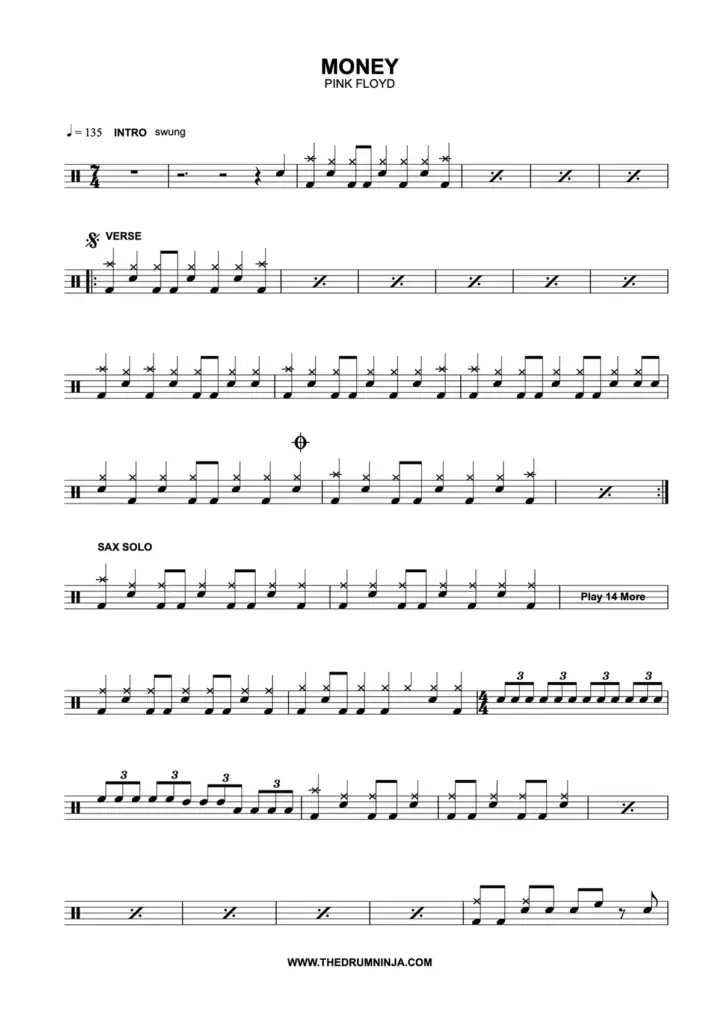
The Money drum transcription is the chart that proves an odd time signature doesn’t have to sound odd.
Most drummers meet 7/4 through progressive rock and expect it to feel clever and complicated. Money does the opposite. It’s a blues, played with a swing, that happens to have seven beats in every bar.
Nick Mason never makes the meter the point. He plays the groove, and the groove carries the listener through the extra beats without them noticing anything unusual happened.
The song starts without a single drum hit. Roger Waters built the intro from a tape loop of coins dropping into a mixing bowl, a piece of paper being torn and a cash register, all spliced together by hand so that each sound lands on one of the seven beats.
Waters worked on the loop with engineer Alan Parsons at Abbey Road. After two measures the bass enters with the riff, then the guitars and drums join. Waters wrote the riff on an acoustic guitar and chose the odd meter because it suited the bluesy feel of the song.
The band started recording the track on 6 June 1972, and Mason overdubbed his drums afterwards. The full story of the album sessions is documented through the official Pink Floyd archive at pinkfloyd.com.
For the verses, the first thing to get right is the count. Seven quarter notes per bar is the framework, and it helps to think of it as a group of four followed by a group of three.
Spend time with the bass riff before you touch the kit, because the riff tells you exactly where the bar resets. The eighth notes are swung throughout, which means the feel is closer to a shuffle than to a straight rock pattern.
Playing it straight is the most common mistake, and it makes the whole groove stiff.
At 120 BPM the tempo is moderate, but counting in seven while keeping a swung feel is harder than it looks. Start at roughly 90 BPM and build up.
Our free online drum metronome is the right tool for this. Set the click to quarter notes, count to seven out loud and loop a single bar until the bar line stops feeling like a wall.
After the saxophone solo, the band accelerates into a swinging 4/4 for David Gilmour’s guitar solo, which runs across three choruses of a 24 bar blues.
This is where the chart changes character. During the second chorus the band pulls back, and Mason plays swinging, syncopated phrases on the toms and snare. An overdubbed hi-hat playing eighth note triplets sits underneath, so you won’t hear it as part of his live performance, but it’s notated in the chart because it defines the feel of the section.
Triplet phrases, both quarter note and eighth note based, run through this whole part, so make sure you’re comfortable with triplets before you start. Our drum notation guide will help you read the triplet markings and the time signature changes clearly.
The transition from 7/4 into 4/4 is the moment to practice on its own. It isn’t just a change of count. The tempo lifts and the feel opens up, and you have to make that jump without rushing or hesitating on the downbeat. Loop the last bar of 7/4 into the first bar of 4/4 until it feels automatic.
For a similar exercise in odd meter, this time in 5/4 with a much more technical drum part, the YYZ drum transcription is the natural next step.
Money teaches you to make an odd time signature groove. YYZ teaches you to play in one with precision.
If the swing feel is the part that gives you trouble, our section on common drum beats covers the shuffle and swing patterns that this kind of blues groove grows out of.
This chart lives in our free drum transcriptions library alongside 160+ others.
Difficulty: Intermediate
Tempo: ~120 BPM
Time Signature: 7/4 in the verses, 4/4 in the guitar solo
Key Technique: Counting and feeling 7/4, swung eighth notes, tom and snare phrasing in the solo, triplet subdivisions, clean transition between meters.