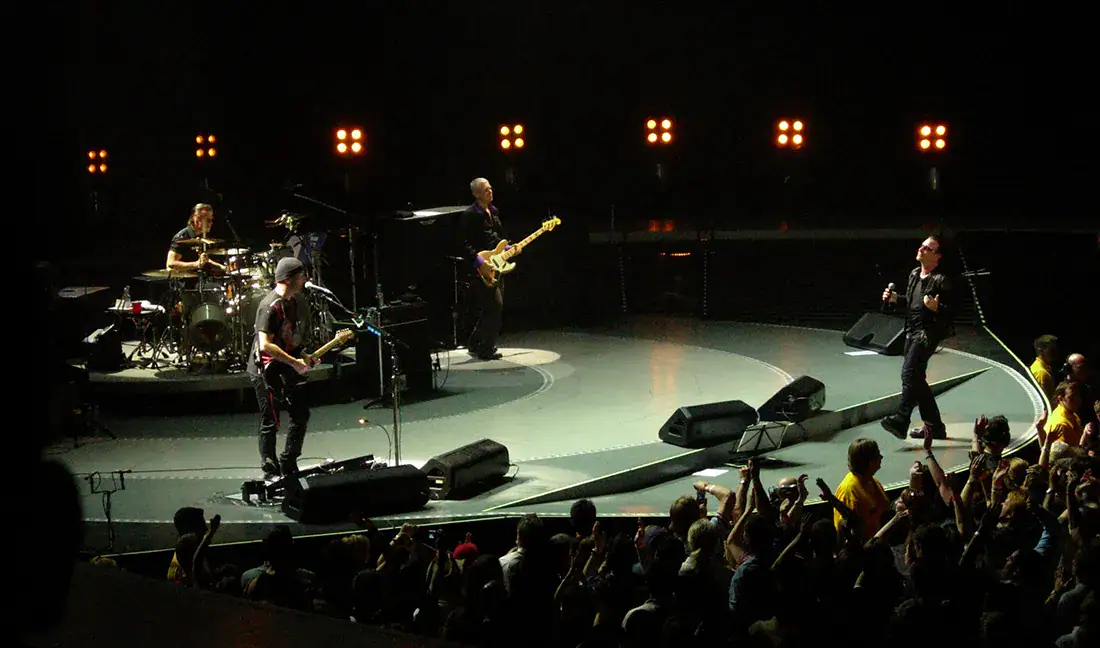
The Take Me Out drum transcription teaches you something that most rock drummers don’t practice enough: the intentional tempo drop.
The song opens at a fast, jagged pace, all angular guitar and nervous energy. Then it shifts, deliberately and dramatically, down to a completely different tempo for the main groove.
That drop isn’t a mistake or a production quirk. It’s a compositional decision, and Paul Thomson executes it every single time with the kind of precision that makes it sound like the song was always going to land exactly there. Getting that shift locked in cleanly is the first real challenge in this chart.
Paul Thomson was the original drummer for Franz Ferdinand from their formation in Glasgow in 2001 until his departure in 2021. Take Me Out came from their debut album and became one of the defining indie rock songs of that decade, reaching number three in the UK and drawing a generation of new listeners toward a sound that deliberately borrowed from post-punk and disco in equal measure.
Thomson’s drumming was central to that identity. The Franz Ferdinand official site at franzferdinand.co.uk has full documentation of the band’s history and recordings for anyone who wants deeper context on where this track sits in their catalogue.
Once the main groove settles in, the chart becomes a study in dance-punk fundamentals. The kick drum sits on every quarter note, four-on-the-floor, steady and anchored through the entire section. The hi-hat plays off-beat barks rather than a continuous 8th-note pattern, which gives the groove its characteristic jerky, dancefloor quality.
Most drummers who come from a straight rock background will want to fill those spaces with more hi-hat. The discipline here is to resist that and trust the space. The groove works because of what isn’t there as much as what is.
The coordination between the four-on-the-floor kick and the off-beat hi-hat accents is the primary technique challenge in this transcription. They don’t land together, which means your limbs need to be genuinely independent rather than just doing variations of the same rhythmic idea.
If that kind of coordination is new to you, our drum notation guide will help you follow what’s happening in the chart before you try to get it under your hands.
And if you want to develop the underlying independence more systematically, the foundational patterns in our common drum beats section are a good place to build from.
The snare placement is worth attention too. Thomson keeps the backbeat clean and direct, no ghost notes, no extra decoration. The simplicity is the point.
When everything around you is this rhythmically specific, adding ornamentation just creates confusion. This is another song where what you leave out matters as much as what you play.
For a similar exercise in dance-influenced indie drumming where four-on-the-floor kick and restrained hi-hat work together to create energy, the American Idiot drum transcription makes an interesting comparison.
Tré Cool and Paul Thomson are very different drummers but both understood the same thing: in a song built for a crowd, clarity and consistency in the groove will always do more than complexity.
This chart lives in our free drum transcriptions library alongside 160+ others.
Difficulty: Beginner / Intermediate
Tempo: ~142 BPM intro dropping to ~105 BPM main groove
Time Signature: 4/4
Key Technique: Intentional tempo drop between intro and main groove, four-on-the-floor kick pattern, off-beat hi-hat barks, limb independence, disciplined restraint throughout.