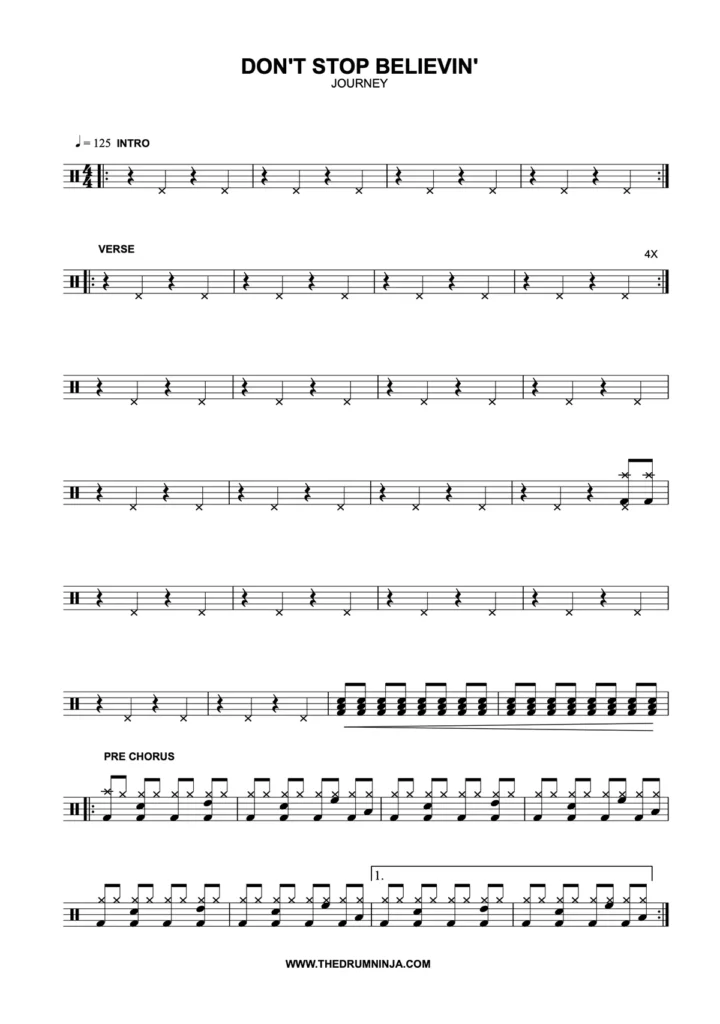
The Don’t Stop Believin’ drum transcription is proof that a drum part doesn’t need to be flashy to be unforgettable.
Steve Smith is a jazz drummer at heart. He’s said as much himself, and if you listen closely to his fills throughout this song, you can hear that sensibility peeking through even inside a straightforward rock arrangement.
But what makes this performance so enduring isn’t technical complexity. It’s restraint, precision, and a deep understanding of what the song actually needed.
Smith has described how he approached the part almost like a composer, treating the drums as a melodic accompaniment rather than just a rhythmic foundation.
He’d record band rehearsals, take the tapes home, and develop the patterns further before bringing them back. He even started practicing open-handed specifically so he could execute the parts he was hearing in his head.
That’s a level of intentionality you don’t often associate with a song this immediately catchy, and it’s exactly why the part holds up forty years later.
The verse groove is deceptively simple to read and surprisingly demanding to play well. The bass drum is the most prominent voice in the part, driving four-on-the-floor with real power behind every hit.
If you play it timidly, the whole groove loses its forward momentum. The hi-hat work, by contrast, asks for the opposite touch. Smith plays it light, using the tip of the stick rather than the shoulder, which keeps the part from ever feeling heavy-handed even while the kick is doing serious work underneath.
Our drum notation guide will help you get comfortable reading the dynamic markings in the chart before you sit down with it, since the contrast between the kick and hi-hat touch is really the heart of this groove.
The snare deserves its own callout. The song’s producer specifically asked Smith not to play rimshots and to hit dead center on the drum instead. That’s an unusual instruction, and it shapes the entire character of the recording.
A rimshot would have given the backbeat more crack and edge. Hitting dead center gives it a rounder, fuller tone that sits differently in the mix. If you’re trying to match the record exactly, this is one of the first things to adjust, and it’s a good reminder that where you strike the head matters just as much as how hard.
The chorus is where the part opens up, with Smith moving to the ride and bringing in bell accents that punctuate the vocal melody. Those bell hits need to be clean and decisive.
They’re doing real melodic work in the arrangement, almost answering the vocal line rather than just keeping time underneath it. Getting the timing and weight of those accents right is one of the more satisfying parts of learning this chart.
For a similar exercise in disciplined, song-serving drumming where every choice supports the bigger picture rather than showing off, the Tom Sawyer drum transcription makes an interesting contrast.
Neil Peart and Steve Smith come from very different places technically, but both understand that the song always comes first.
If working through this chart gets you thinking about dynamics, touch, and how much a single stroke can communicate, our online drum lessons section covers the technique fundamentals that make those details possible.
This chart lives in our free drum transcriptions library alongside 160+ others.
Difficulty: Intermediate
Tempo: ~125 BPM
Time Signature: 4/4
Key Technique: Four-on-the-floor kick with power, light hi-hat touch using stick tip, center-struck snare for tone, ride bell accents in the chorus.