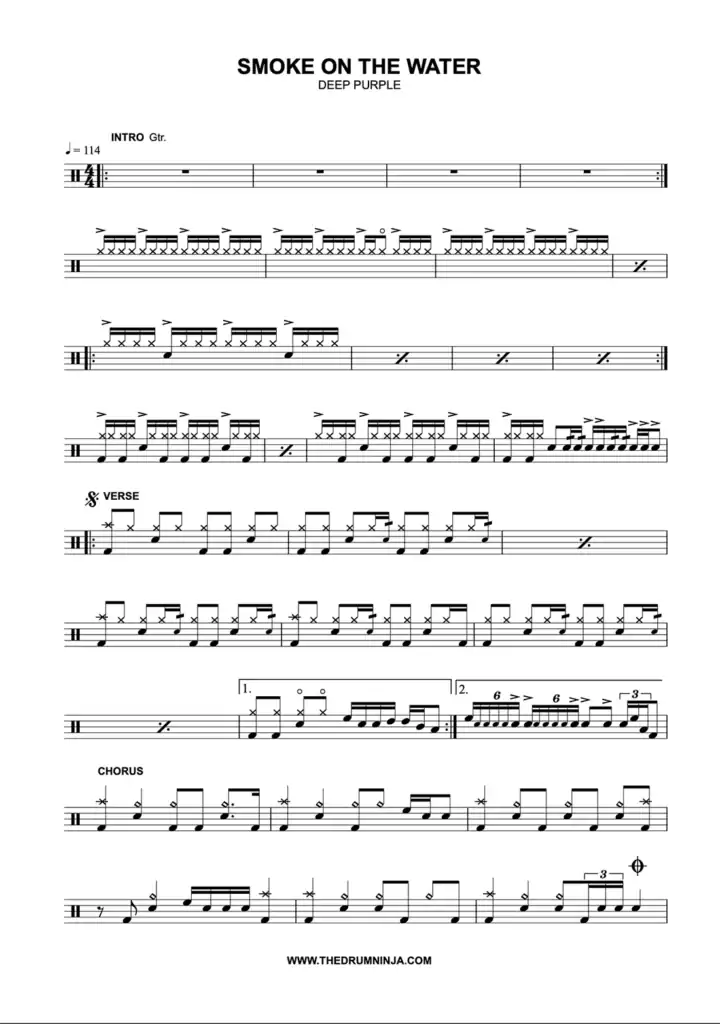
The Smoke on the Water drum transcription is one of the best lessons in what it actually means to serve a song.
Everyone knows the riff. Most people don’t know the drums. That imbalance tells you something important about how well Ian Paice did his job.
His part is so locked in, so precise, and so tasteful that it disappears into the track in the best possible way, holding everything together while Ritchie Blackmore’s riff and Jon Lord’s Hammond organ take all the credit.
Music producer Bobby Owsinski put it well: “the precision of his drumming frequently goes unacknowledged, but a serious listen shows what a master he really is.
The fact that he makes it sound and look so easy is exactly what makes the parts work.” That’s the thing to carry into this chart. It sounds easy. It isn’t.
The intro opens with 16th notes on the hi-hat before the band enters, setting the tempo and tension before a single note of the riff has been played.
When the verse kicks in, Paice drops to 8th notes on the hi-hat and locks in with one of the most solid pocket grooves in hard rock history. The syncopated hi-hat accent pattern throughout the verse is the first real challenge in the chart.
The accents fall in unexpected places relative to the kick and snare, and getting them right without rushing the downbeats takes more careful attention than the groove’s relaxed feel suggests.
The kick drum drops are the other key detail. Paice places displaced kick hits that fall slightly outside where you’d instinctively expect them, creating a subtle forward lean in the groove that gives the song its drive.
This is a technique worth studying closely because it’s the kind of thing that separates drummers who know how to lock in from drummers who just keep time. If you want to understand how reading these patterns works on paper before you play them, our drum notation guide will walk you through it clearly.
The fills that bridge each section are where Paice’s technique shows up most visibly. Quick, single-stroke snare fills before each chorus that require real wrist speed and precision to sit correctly at tempo.
The final fill uses a six-stroke roll pattern (RLLRRL) that catches most players off guard the first time they try to read it. Slow it down, isolate it, and get it under your hands before you try to put it back into context. The payoff when it locks in is one of the better feelings this chart has to offer.
For a similar exercise in classic hard rock pocket drumming where feel and precision matter more than flash, the Back in Black drum transcription is the natural companion.
Phil Rudd and Ian Paice never overplayed a note between them, and studying both charts in the same session reveals a lot about what made that era of rock drumming so enduring.
Once you’ve got the groove and fills down and want to work on the dynamic control that makes this kind of playing feel live and powerful, our section on common drum beats covers the foundational concepts that underpin classic rock grooves like this one.
This chart lives in our free drum transcriptions library alongside 160+ others.
Difficulty: Beginner / Intermediate
Tempo: ~114 BPM
Time Signature: 4/4
Key Technique: 16th-note hi-hat intro, syncopated hi-hat accents, displaced kick drum drops, single-stroke snare fills, six-stroke roll in the final fill.