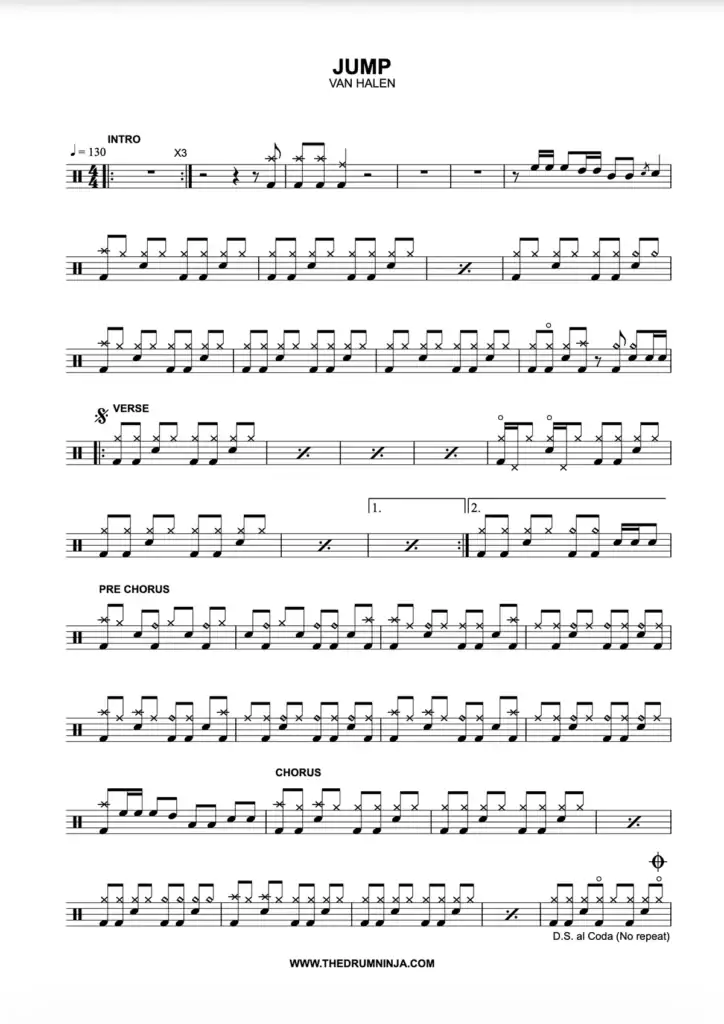
The Jump drum transcription teaches patience before it teaches anything else.
Two minutes and fifteen seconds of synthesizer before the drums enter. For a band whose live shows were defined by Alex Van Halen’s explosive, technically staggering drum performances, Jump is the great exercise in restraint.
He sits out the entire opening, lets the keyboard riff establish the song’s identity, and then enters with a groove that is exactly what the song needs and nothing more.
That discipline is the first thing this chart asks of you.
The story behind Jump is one of the more unusual in classic rock. Eddie Van Halen wrote the keyboard arrangement years before the album was recorded, but the rest of the band repeatedly rejected it for being too pop-oriented for Van Halen’s image. It took producer Ted Templeman’s enthusiasm to finally get everyone to commit to recording it.
The song was tracked at Eddie’s own home studio, Five Van Halen Studios, which he had built specifically to have full creative control over the recording process. Jump became Van Halen’s only number-one single on the Billboard Hot 100. The full history of the 1984 sessions is documented through the official Van Halen archive at van-halen.com.
There’s an irony worth knowing about Alex Van Halen that changes how you hear this performance. As teenagers, while Eddie was working a paper route to pay off his drum kit, Alex would secretly practice on it while Eddie was out.
By the time Eddie came home, Alex had become a better drummer than his younger brother. Eddie switched to guitar. Alex took the kit permanently.
The patient, controlled groove on Jump is the work of one of the most technically capable drummers of his generation consciously choosing to hold back.
The groove itself begins with a distinctive left-hand snare pattern that gives the beat its slightly syncopated character from the first bar. The kick drum locks in solidly and the hi-hat drives the 8th-note pulse forward.
What makes the drum part interesting to study is how much of the song’s commercial momentum Alex creates from a relatively spare arrangement. No excessive fills, no showboating, just a consistent pocket that gives David Lee Roth’s vocal and Eddie’s guitar exactly the space they need.
If you’re new to reading notation, our drum notation guide will help you follow the left-hand snare pattern clearly before you put it together with the rest of the kit.
The fills, when they do arrive, are short and purposeful. Quick snare runs leading back into the downbeat, placed at the transitions between sections.
Alex uses them to signal the song’s structural shifts without pulling focus from the track’s melodic identity. That economy is worth studying carefully because it’s the opposite of what most people associate with Van Halen drumming from this era.
For a contrast that shows the other side of Alex Van Halen’s playing, the drum transcription for Hot for Teacher from the same album is a completely different proposition, one of the most technically demanding drum intros in hard rock. Jump and Hot for Teacher together give you a complete picture of what he was capable of across a single record.
The sustained pocket at this tempo is more demanding than it sounds on first listen. At 129 BPM, keeping the hi-hat and kick absolutely consistent across a five-minute track requires the kind of stamina that only comes from playing through the full song at tempo rather than working on sections in isolation.
wOur guide to common drum beats covers the foundational groove development that builds that consistency over time. And if you’re practicing with an electronic kit and want to make sure your hi-hat touch is coming through clearly, our guide to the best electronic drum sets covers which kits respond accurately to the kind of dynamic variation this groove rewards.
This chart lives in our free drum transcriptions library alongside 160+ others.
Difficulty: Beginner / Intermediate
Tempo: ~129 BPM
Time Signature: 4/4
Key Technique: Delayed entry at 2:15, left-hand snare syncopation, consistent hi-hat and kick pocket across full song length, restrained fill placement at section transitions.