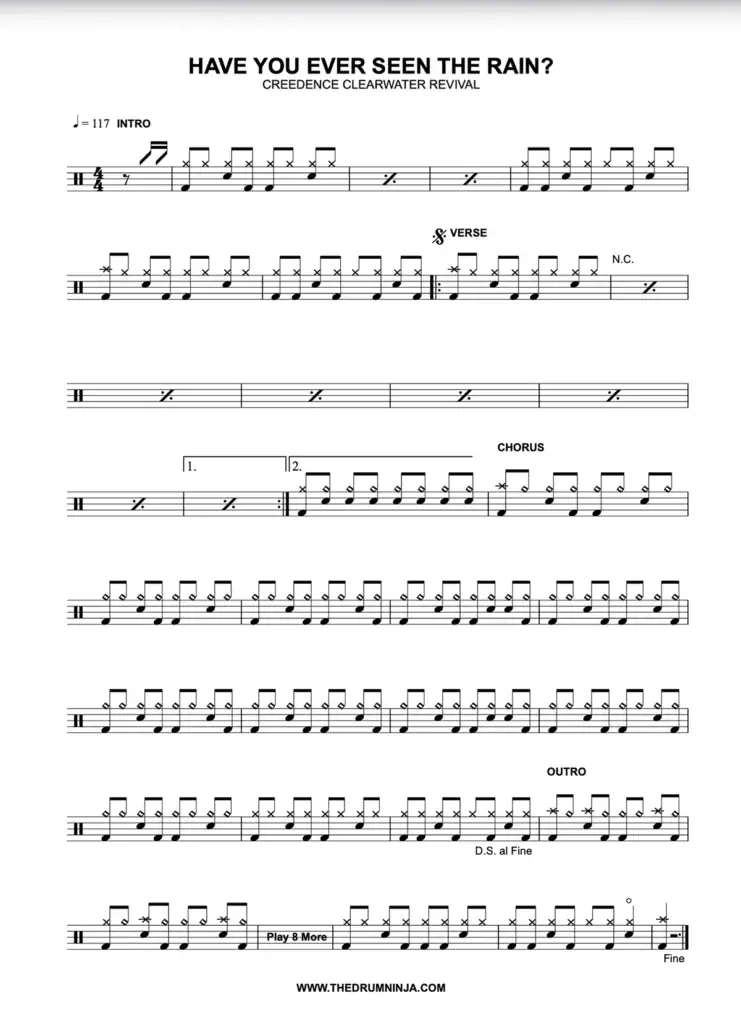
The Have You Ever Seen the Rain drum transcription is one of the cleanest lessons in tasteful simplicity that classic rock has to offer.
Doug Clifford is one of the most underrated rhythm section drummers of his era. CCR sold over 26 million records during their commercial peak, and Clifford’s drumming is on every one of them, holding down a groove that sounds effortless because he worked to make it effortless.
That’s a different skill from playing something complicated. It’s harder to teach and harder to execute, and this song demonstrates it better than almost anything else in the catalogue.
The song came out of a difficult moment for the band. According to John Fogerty, writing in American Songwriter, the lyric “have you ever seen the rain coming down on a sunny day” was drawn from the band’s internal unease at the height of their fame, a feeling that something was wrong even when everything looked right.
The band was fractured, Tom Fogerty was about to leave, and the song carries that tension in a way that never makes it to the surface of the arrangement. Clifford knew exactly what the song needed, and he played that, nothing more.
More context on the recording and the band’s history during this period is available through the official CCR archive at creedenceclearwaterrevival.com.
The first chart detail worth noting before you sit down with this one is the hi-hat. The transcription marks it slightly open throughout the intro and verse, not fully open, not fully closed.
That small variation in foot pressure changes the character of the groove completely. A closed hi-hat at this tempo sounds tight and controlled. A slightly open hi-hat at this tempo sounds warm and relaxed, like the song is breathing.
Getting that touch consistent requires attention because the tendency is to clamp down on the hi-hat pedal out of habit and lose the looseness that makes this groove feel the way it does.
The second detail is the crash cymbal. On the original recording, Clifford omits the crash on repeated verses. He opens the section, establishes the feel, and then pulls back on the accent for the repeats.
It’s a dynamic choice that keeps the song from flattening out over its two and a half minutes, and it’s the kind of thing that separates drummers who read charts from drummers who listen to recordings.
Our drum notation guide will make sure you’re tracking those markings clearly before you play through the full chart.
The fills are minimal and perfectly placed. Short snare runs leading back into the one, mostly two to four notes. Nothing that pulls focus from John Fogerty’s vocal or the acoustic guitar that anchors the arrangement.
This is the discipline that makes CCR recordings hold up fifty years later, every instrument in exactly the right amount, nothing competing with anything else.
For a similar exercise in groove-first, song-serving rock drumming at a comparable tempo and feel, the Don’t Stop Believin’ drum transcription is a natural companion.
Steve Smith and Doug Clifford are very different players in different eras, but both understood that the drummer’s job in a song like this is to make the song feel good, not to announce themselves.
If this chart is part of a wider focus on developing a consistent groove and building your sense of dynamic control, our section on common drum beats covers the foundational patterns that this kind of playing grows out of.
And if you’re practicing with headphones on an electronic kit and finding it hard to hear the hi-hat subtleties that make or break this groove, our guide to the best headphones for electronic drums covers what to look for when detail in the high frequencies actually matters.
This chart lives in our free drum transcriptions library alongside 160+ others.
Difficulty: Beginner / Intermediate
Tempo: ~117 BPM
Time Signature: 4/4
Key Technique: Slightly open hi-hat throughout verse, dynamic crash placement, minimal fill vocabulary, consistent relaxed pocket across the full track.