



Roland TD516 Review
Practical Buying Guide
I’ve been waiting for Roland to bridge the gap between their mid-range and flagship lineup for a while. With the TD516, they finally did it.
This kit dropped in October 2025 and sits in a genuinely interesting spot. You’re getting the V51 module, which runs the same core sound engine as Roland’s top-of-the-line V71. Same sounds.
Same DW-recorded library. Same expressiveness. The difference between the TD516 and the flagship is mostly about I/O and acoustic shell design, not about what you hear through your headphones.
For a working drummer who practices at home, records to a DAW, and occasionally plays live, that’s a very compelling argument.
In this review, I’ll break down whether the Roland TD516 actually delivers on that promise and who it’s really built for.
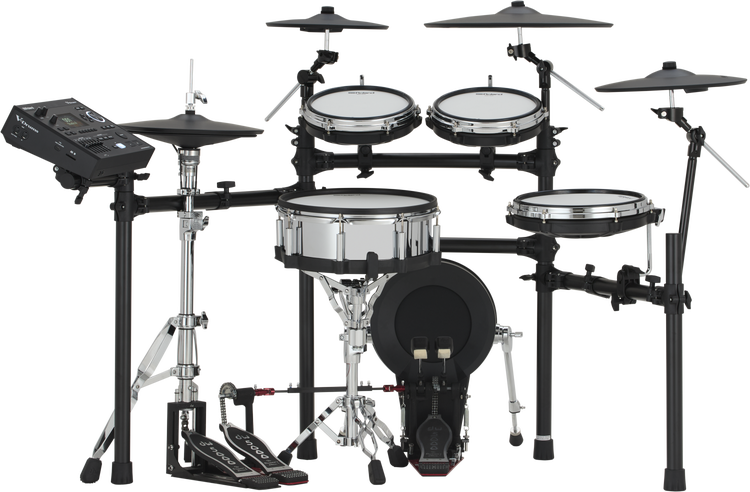
Features
Here’s what ships with the TD516:
Module
- V51 Sound Module — same sound engine as the flagship V71
- DW Soundworks sample library (DW-recorded, multi-layered)
- Roland Cloud integration for downloadable expansion packs
- WAV sample import via SD card
- Built-in WiFi and Bluetooth
- USB-C multitrack output (individual drum channels to your DAW over one cable)
- MIDI In/Out, L/R stereo outputs, two direct outs
Pads and Cymbals
- PD-140DS 14″ digital snare with positional sensing
- VH-14D 14″ two-piece digital hi-hat (stand-mounted)
- CY-18DR 18″ digital ride with bell, bow, and edge zones
- CY-14C-T 14″ and two CY-12C-T 12″ crash cymbals with choke
- Two PD-10P 10″ tom pads, one PD-12P 12″ floor tom
- KD-12 12″ kick tower, double-pedal compatible
Stand and Extras
- MDS-STD3 four-post rack (upgraded from TD-27’s MDS-STD2)
- Three digital pad inputs (vs one on the TD316)
- Built-in coaching tools: Phrase Trainer, Stroke Monitor, Blast Beat Builder, Time Check, Quiet Count
+
Things We Liked
- V51 module runs the same sound engine as Roland's flagship V71
- Three digital pad inputs covering snare, hi-hat, and ride simultaneously
- PD-140DS snare with positional sensing handles ghost notes, rimshots, and brush sweeps with genuine nuance
- VH-14D digital hi-hat registers half-open positions and touch-muting naturally
- USB-C multitrack output makes DAW recording plug-and-play
- Built-in WiFi and Bluetooth for Roland Cloud and wireless audio
- KD-12 kick is double-pedal compatible
−
Things We Didn't Like
- Snare is the PD-140DS rather than the PD-14DSX found in the VAD516 — the DSX has a wider, more acoustic-diameter playing surface
- No throne or bass drum pedal included — budget an additional $150 to $250
- At $3,699, it sits in genuinely competitive territory against the Yamaha DTX8K and other mid-tier alternatives
Summary
The V51-powered kit brings flagship Roland digital technology to a more compact footprint. While the price and hardware omissions require careful budgeting, the elite sound engine and industry-leading digital pads make it a powerhouse for recording and practice.
What to Expect from this Electronic Drum Set:
Quality
The first time I played through the V51 module on a good pair of headphones, I stopped and just listened for a minute.
The DW Soundworks library doesn’t sound like a drum machine approximating an acoustic kit. It sounds like an actual DW kit recorded in a real room.
The dynamic range is wide enough that a quiet ghost note genuinely sounds different from a powerful backbeat, not just softer, but texturally different in the way acoustic drums are.
The dynamic range is wide enough that a quiet ghost note genuinely sounds different from a powerful backbeat, not just softer, but texturally different in the way acoustic drums are.
That’s the thing about shared architecture between the V51 and V71. Roland didn’t create a budget version of the sound library. The same samples are running in both modules.
What you pay more for in the VAD716 and TD716 is the acoustic shell construction and the larger, more physically immersive pad experience, not better-sounding drums.
What you pay more for in the VAD716 and TD716 is the acoustic shell construction and the larger, more physically immersive pad experience, not better-sounding drums.
For most drummers, especially those focused on improving their technique at home, the sound quality difference between this kit and Roland’s $9,000 flagship is not where the money goes.
Construction
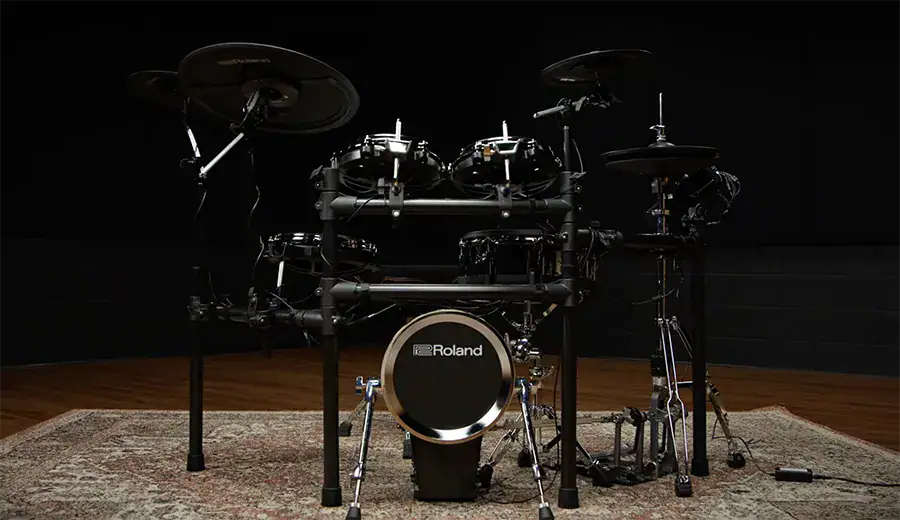
The MDS-STD3 rack is solid. Roland made genuine improvements over the previous generation here, the four-post design reduces wobble under aggressive playing, and the clamp hardware feels properly engineered rather than good enough.
The three digital pads are where the TD516 separates from everything below it. The PD-140DS snare uses positional sensing to track where across the head you strike, adjusting sound in real time.
Ghost notes at low velocity register cleanly and distinctly from centerstrokes. Cross-sticks sound like cross-sticks, not like muffled snare hits. The VH-14D hi-hat is, in my opinion, the best electronic hi-hat in a rack-based kit right now.
Foot control from fully closed through half-open to open and foot splash all register naturally, the same way a quality acoustic hi-hat does under your foot.
One honest note: the PD-10P and PD-12P tom pads are on the smaller side. Coming from acoustic toms, there’s an adjustment period. It’s not a dealbreaker, but it’s worth knowing before you sit down for the first time.
If larger tom surfaces are a priority, the Roland VAD516 with acoustic shell dimensions is worth the step up.
Performance
The TD516 performs like a professional instrument because it is one.
The snare and hi-hat together are what make it feel that way. I can play soft, technical passages with detailed ghost notes and the kit registers every one of them.
I can switch to loud, aggressive playing and nothing clips or distorts. That dynamic range across the full velocity spectrum is what separates a module tracking at 1.9ms latency from something cheaper that compresses the quiet end of your playing into mush.
I can switch to loud, aggressive playing and nothing clips or distorts. That dynamic range across the full velocity spectrum is what separates a module tracking at 1.9ms latency from something cheaper that compresses the quiet end of your playing into mush.
The CY-18DR ride is the same pad Roland has put in their professional lineup for years, and for good reason. The bell zone is large enough to strike without having to aim for it.
Positional variation across the bow gives you genuine tonal difference between tip and shank strokes. It’s one of those pads where you stop thinking about the pad and start thinking about the music.
Positional variation across the bow gives you genuine tonal difference between tip and shank strokes. It’s one of those pads where you stop thinking about the pad and start thinking about the music.
The KD-12 kick tower is wider than the KD-10 that shipped with the TD-27, and it handles double pedal setups cleanly. If you’re into double bass, you won’t run into problems here.
For home recording, the USB-C multitrack output is a genuine game-changer at this price point. One cable into your computer, and every drum and cymbal appears as its own track in your DAW.
No audio interface, no latency-adding conversion chain. Just multitrack drum recording from your home kit at studio quality.
No audio interface, no latency-adding conversion chain. Just multitrack drum recording from your home kit at studio quality.
Prive to Value:
The TD516 retails at $3,699. That’s a serious number, and I’m not going to pretend otherwise.
But when you understand what’s inside the box, the math holds up. The V51 module alone is worth over $1,200. The PD-140DS snare, VH-14D hi-hat, and CY-18DR ride together represent well over $1,500 in component value.
The total hardware value of this kit exceeds its bundle price. That’s not marketing, that’s just how Roland prices their bundles.
The Sweetwater promotion running through June 30, 2026 adds a free drum rug and throne worth $467. That fills in two of the items not included in the box and meaningfully closes the gap on what you’d otherwise spend to be ready to play.
For context on where this fits in the broader market, our guide to the best electronic drum sets covers how the TD516 stacks up against Yamaha, Alesis, and every other serious option currently available.
And if you’re specifically comparing Roland models, our best Roland electronic drum sets breakdown ranks every V-Drums kit in the lineup.
The TD316 at $2,499 is the natural alternative to consider. You give up two of the three digital pad inputs and lose the direct outputs.
For home practice, that trade makes sense. For recording and performing, it starts to feel limiting quickly. The TD516 is built for drummers who’ve outgrown the “just for practice” bracket.
Roland TD516 Review
-
Build Quality
-
Performance
-
Price to Value
4.7
Conclusion
Roland built the TD516 for a specific drummer: someone who’s serious enough about their playing to want flagship sound quality and professional I/O, but doesn’t need the acoustic shell construction of the VAD series.
That’s a real market, and the TD516 serves it exceptionally well. The V51 module sounds incredible, the digital pad trio gives you expressiveness that cheaper kits simply can’t match, and the USB-C multitrack output makes home recording feel effortless.
It’s not perfect. The tom pads are smaller than acoustic, there’s no pedal or throne included, and $3,699 requires genuine commitment. But if you’re at the point in your playing where those things matter, this kit will meet you there.
The Roland TD516 is one of the best electronic drum sets available right now. Full stop.